Christmas in Miraflores: a message for our entire communityRead More

Newsletter Miraflores

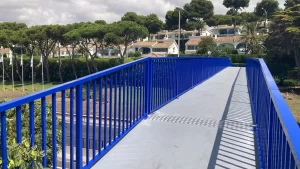
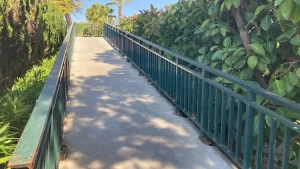
We are pleased to inform all property owners and residents of the Entidad de Conservación Hacienda Miraflores that the refurbishment works on the pedestrian bridge have been successfully completed.
After several months of specialised technical work, the bridge now has a fully secure and reinforced structure, adapted to current usage needs. The project has met all its objectives: structural reinforcements, complete replacement of the railings, comprehensive concrete treatment and the application of a new non-slip surface—all carried out under the supervision of the appointed engineer and with continuous monitoring by the administration team.
In addition to improving the safety and stability of the bridge, special care was taken to ensure the visual integration of the structure within the urban environment, preserving the character and functionality of this important pedestrian link in our community.
We would like to thank all owners for their patience and cooperation during the works. Thanks to this joint effort, we can proudly say that Miraflores now has a safer, stronger and fully operational pedestrian bridge, ready to continue serving as a secure crossing point for residents, visitors, and future generations.
Pedestrian Bridge Refurbishment Successfully Completed in MirafloresRead More

The Miraflores Pedestrian Bridge Enters a New Phase of Renovation to Improve Safety and Accessibility
Residents of Hacienda Miraflores will soon notice visible progress in one of the community’s most frequently used structures: the pedestrian bridge. This well-known walkway, which connects key areas of the urbanisation and forms part of many neighbours’ daily routines, is entering a new phase of refurbishment focused on improving safety, accessibility, and comfort for all who use it.
A renovation designed with pedestrians in mind
The planned works include a full structural upgrade of the bridge, featuring a new, safer handrail, non-slip paving, and enhancements to ensure greater durability. Special protective coatings will be applied to guard against wear and tear, and drainage elements will be added to help manage rainwater—contributing to the bridge’s long-term upkeep and functionality.
These improvements go beyond technical updates. They are aimed at ensuring that residents and visitors—especially children, older adults, and people with reduced mobility—can cross the bridge with greater safety and peace of mind.
Temporary closure for safety reasons
To carry out these works, the pedestrian bridge will be closed from 26 May onwards. This temporary measure is necessary to guarantee both pedestrian safety and the smooth execution of the renovation. The bridge will reopen as soon as the construction company confirms it is safe to do so, and residents will be notified through the usual communication channels.
The Conservation Entity would like to thank all residents for their understanding during this brief disruption, and reminds everyone that the ultimate goal is a safer, more modern bridge—adapted to the current needs of the entire community.
Further Progress in the Full Renovation of the Miraflores Pedestrian BridgeRead More
Miraflores 02/05/2024
Progress continues on the pedestrian bridge works connecting Miraflores with the beach, which began on the 8th of April. The works are advancing at a good pace and, if this continues, the scheduled deadlines are expected to be met.

Currently, the removal of the deteriorated concrete layer is being carried out, a crucial task to ensure the safety and durability of the bridge. Additionally, a general sanitation is being undertaken in the most affected areas on both sides of the structure, ensuring that the bridge is not only safe but also aesthetically pleasing for all users.
From the administration of Gran Comunidad Miraflores and the companies in charge of the works, Retineo and Cemosa, we wish to thank the residents for their civility and patience during this process.
It is important to highlight that, although the bridge is partially accessible, we strongly advise against its use until the works are completely finished, for everyone’s safety. If it is essential to cross the bridge during the works, please follow all the safety recommendations set out in the temporary signs and remember that it is at your own risk.
With Cemosa’s supervision and Retineo’s experience in rehabilitation, we ensure that the bridge will not only meet the highest standards of quality and safety but will also represent a step forward in the continuous improvement of our community’s infrastructure.
This project not only symbolises a physical link between Miraflores and the beach but also the commitment of our community to the safety and well-being of all residents.
We deeply appreciate your cooperation and look forward to successfully completing this project, significantly enhancing the quality of life and safety in our environment.
Here you will find some photos that reflect the ongoing works.
Significant Progress in the Remodelling of Miraflores’ Pedestrian BridgeRead More
Miraflores, 04/04/2024
Miraflores Grand Community celebrates the start of work on the remodelling of the pedestrian bridge that connects our urbanisations with the beach and the Ronda Litoral promenade.
The existing pedestrian bridge was in a state of disrepair which was of concern to residents. Its structure needed urgent improvements to avoid risks and lack of safety for users.
The refurbishment of the pedestrian bridge has been a priority for the administrator of Miraflores Grand Community and the management team. For this project, leading companies in this type of construction, such as Retineo and Cemosa, have been contracted and have put all their experience at the service of the community.

Retineo, with its extensive experience in engineering and rehabilitation, will be responsible for carrying out the refurbishment of the bridge. It should be noted that this company has been awarded the government contract for the repair of 12 footbridges on the Costa del Sol.
Their commitment to excellence and track record of success gives us confidence that the new bridge will be a safe structure that will stand the test of time.
Supervision and quality control of the work will be provided by Cemosa, a leading company in the infrastructure sector. Their rigorous and meticulous approach will ensure that the new bridge meets the highest standards of safety and functionality.
Start date: 8 April
Duration: approximately 3 months
The refurbishment works on the pedestrian bridge will start on 8 April next and are estimated to last 3 months.
During this time, the bridge will be closed to pedestrian traffic for a maximum of 2 weeks, in order to minimise inconvenience to residents. When this time comes, the dates of the pedestrian traffic interruption will be communicated.

The refurbishment of the pedestrian bridge will not only provide greater safety for residents who use it daily, but will also strengthen the connection between Miraflores and the beach, promoting mobility and integration with other points along the coast.
This project represents a step forward in the development and improvement of the quality of life in Miraflores. It is a sign of the administration’s commitment to the well-being of residents and to creating a safe and pleasant environment for all.
Without the drive of Urszulla Karlsson as president and Ole Sigursson as vocal of infrastructure, together with the coordination of more than 3 years by our administrator Meridional, this project would not have been possible.
Choosing the best companies to participate in the project and obtaining advantageous financing to achieve this project, which has been in demand for years, has been a priority at all times.
Both the board of directors and Meridional would like to thank the residents in advance for their patience and understanding during the works.
We are confident that the refurbishment of the pedestrian bridge will be a success and a substantial improvement to our environment for years to come.
As we all know, there is an emergency situation affecting our community and the whole Costa del Sol. The Junta de Andalucia has declared a situation of «serious and exceptional shortage» due to the drought in our region.
The Town Hall of Mijas, to which our community belongs, issued a proclamation on 13 November 2023, which is still in force, requesting the maximum cooperation of its citizens and obliging the adoption of measures to restrict the use of drinking water. These measures include a ban on watering gardens, golf courses, washing streets, filling private swimming pools, washing cars, among others.

As the situation has not improved, Acosol, which is the public company managing the integral water cycle for the municipalities of the Western Costa del Sol region and the Mijas Town Hall have taken new measures to manage water resources in the face of the drought, highlighting the reduction of water consumption and investments in infrastructure to ensure the supply.
For a better understanding, we will try to break down the main measures:

New water regulation measures in Mijas due to the droughtRead More
Dear owner,
On these very special dates, I want to express my deepest gratitude for your valuable contribution to the coexistence in our community. Thanks to your collaboration, support and commitment, Gran Comunidad Miraflores continues to improve and has consolidated as a place where we all feel at home.
We have strived one more year to create a welcoming, safe and harmonious environment, where respect and coexistence prevail. As president, I assure you that I will continue to work with enthusiasm and responsibility to improve our community for another year.
I invite you to celebrate Christmas with joy and hope, and to let yourself be inspired by the values of peace, understanding and fellowship. Remember that you are a key piece of our community, and that together we form a great family.
I wish you to enjoy these days with your loved ones, and that light and love fill your heart.
With love and good wishes,
Urszula Karlsson
It is a good time to write about more than just the rules in the neighbourhood communities, problems with leaks in the common areas or what taxes you have to pay. Let’s take a break, because we want to tell you about some of the traditions and customs we have in Spain at Christmas time.
During such a special time as Christmas, each country celebrates and lives these dates with its own customs and traditional gastronomy which, on occasions, have much in common and, on others, can be completely different.
We Spaniards have our own particularities when it comes to enjoying these festive weeks, which in our case, take us until 6 January. In case you hadn’t noticed, today we take a look at some of Spain’s most curious Christmas traditions. Have you already incorporated any of them?
If there is one thing that characterises the Christmas decorations in Spanish homes, it is the nativity scene. And while in other places the lights and the details of Father Christmas and his elves, not forgetting the sprig of mistletoe, have been the protagonists, the tradition in this land has revolved for the most part around the nativity scene.
The nativity scene, which represents the birth of the baby Jesus in the village of Bethlehem, can be of any size, from the simplest with its three central figures (the baby Jesus, the Virgin Mary and Saint Joseph) to the most elaborate, which constitute authentic models and miniature villages.

In fact, the nativity scene tradition in Spain has contributed to the fact that many historic nativity scenes are exhibited at this time of year and that going with children to see the nativity scenes in different cultural and public spaces in our city is also a classic at Christmas time.
The traditional Misa del Gallo (Midnight Mass) is celebrated in Spain after Christmas Eve dinner, to celebrate the birth of Jesus. However, in Mallorca (Balearic Islands) they have an even more unique tradition related to this religious act. We are referring to the chant of the Sybil, which has been listed as Intangible Heritage of Humanity by UNESCO since 2010.

It is a chant of medieval origin, with a Gregorian melody and no instrumental accompaniment, performed by a person dressed in a tunic, with a cape and a sword. The chant of the Sibyl takes place in different temples in Mallorca, although the most emblematic are those held in Palma Cathedral and in the Lluc sanctuary.
In the Galician mountains, especially in the area of O Courel and O Cebreiro, there is a figure that competes every year with Father Christmas. This is the Apalpador, a Christmas character who every year, on 24 and 31 December, comes to the houses to feel the children’s tummies to check that they have eaten well during the rest of the year and leaves them presents and a handful of chestnuts. This is one of Galicia’s popular traditions that has been revitalised in recent years.

Every December 28th in Spain a very curious date is celebrated: the Holy Innocents. On this day, tradition dictates that pranks are played on family and friends. Its symbol is a paper doll that represents the innocent person who has fallen for the joke that has been played on him or her.

The origin of this tradition is associated with the festival of the fools that took place in the Middle Ages between Christmas Day and New Year’s Day. It was a day of carnival atmosphere in which ecclesiastical institutions were parodied, people dressed up in costumes and sang obscene tunes.
The Olentzero also leaves gifts for the children of the Basque Country and Navarre. He is a character who leaves the woods where he lives to give presents to children every 24th December. He is a good-natured charcoal-burner, a bit of a rogue and a great lover of food and drink. Another tradition that brings happiness and joy to the youngest members of the family.

Undoubtedly, one of the traditions of Spanish Christmas that makes it unique is the twelve grapes, also known as the lucky grapes. Every 31 December it is customary to take one grape for each stroke of the clock at 00:00 hours to welcome the first day of the year and to do so by invoking good luck.

The origins of this tradition date back to the 19th century, when it was already practised by some bourgeois, drinking grapes and champagne at private parties, but it became popular in 1909, when there was a surplus harvest of white grapes in Alicante and a campaign was launched to link it to New Year’s Eve and expand the custom. And they succeeded.
Every 6 January, the «roscón de Reyes» is a must on the tables of Spanish households, one of those traditions that are so much a part of us and which causes endless queues in patisseries and bakeries all over the country. After Twelfth Night, it is typically eaten for breakfast, as a dessert after lunch or as an afternoon snack.

This large sweet doughnut-shaped pastry hides a bean and a small figure inside. Whoever finds the bean in its piece must pay for the roscón, and whoever finds the figurine, in addition to keeping it as a souvenir, must be crowned king. That is why the roscón is sold with a golden cardboard crown.
22 December is a day full of excitement, because this is the date of the Christmas lottery draw. Almost everyone wants to participate and, in the months leading up to Christmas, people buy lottery tickets that can be shared with friends or family (to spread the luck).

The first Christmas lottery draw was held in 1812. Since 1957, it has been broadcast live on television, and it is common for people to follow it live. The most emblematic? The children of San Ildefonso, who are in charge of singing the winning numbers.
As a curiosity, 22 December is also, unofficially, the Day of Health: in this way, people who do not win the lottery are appealing that, at least, they are in good health.
The Lotería del Niño is, after Christmas, the most important lottery draw in Spain.
Before becoming what we know today, the Sorteo del Niño was a series of draws held as early as the 19th century for charity, to fund a children’s hospital. The idea came from María del Carmen Hernández y Espinosa de los Monteros and in 1868 these games were known as El Niño.
Everyone knows that water is a precious resource and that we must use it responsibly and with the immediate future in mind. That is why in this article we propose some tips to save water at home and in your community of neighbours, with which to achieve a more efficient consumption in both cases.
In Meridional we are very concerned about this period of drought that we are going through and that is why we want to contribute by publishing these tips that we understand to be very useful for the communities that we manage and for the owners who live in them.
If you notice any water leaks in your community, please contact your president so that we can be notified as soon as possible and act quickly. The priority is always to save water both in your home and in the communal areas of the community where you live, whether it is the swimming pool, bathrooms, fountains, irrigation, etc.

If you have had any problem in your house and it has not been solved in an effective way, in Meridional we put at your disposal plumbing professionals.
Rain is not available to us when we need it. Of course, we cannot create «tricks» to control it at our convenience, but we can contribute to the availability of water in other ways. How? By using it responsibly. To summarise all these ways of saving water, here are some tips for efficient consumption.


By following these tips, you can enjoy your community swimming pool without wasting water or money. Remember that taking care of water is everyone’s responsibility and that with small gestures we can make a big difference.
The best tips for saving water at home and in your community of neighboursRead More

Today we will take a closer look at the steps to take in the event of a burglary in your home.. It is good to keep them in mind because they can be important both to receive compensation from the insurance company and to prevent further burglaries.
According to a report by INESE, the largest community of insurance professionals in Spain, it is during the winter and on the Mediterranean coast that the most house burglaries occur.
Home burglaries are a constant concern throughout the year for many foreign homeowners in Spain. Although more than 92,000 home burglaries were recorded last summer in Spain, it is possible to prevent these situations. In addition, it is important to know what to do if your property is burgled in Spain.
As a foreign property owner, it is advisable to keep your property safe through additional security measures, and to be familiar with insurance policies and procedures in Spain. If you suffer a burglary, you should immediately contact the local authorities and your insurance company to report the incident and seek assistance.
A very common question is whether home insurance covers theft. Generally, a home insurance policy will cover 100% of the value of the stolen items, but in the case of theft the cover is usually less and the compensation received will be a lower amount.
However, this may vary depending on the type of burglary or theft suffered and the specific coverages of the insurance policy taken out. It is important to check the specifications of your insurance policy to find out the exact coverage and compensation you may receive.
If you want to know in more detail what are the most common covers that a home insurance policy should include and what damages you may be covered for, you can consult our article on home insurance in Spain in this blog.
The difference between burglary and theft lies in the use of force or violence. Robbery implies that the thief uses force on things or violence or intimidation on people, such as stealing a wallet with a gun or forcing a door to enter a house.
On the other hand, theft refers to the appropriation of another’s property without the use of force, such as a pickpocket stealing a wallet without the victim being aware of it.
The decision to take out home insurance depends on the needs of each homeowner. There are two types of policies: building and contents. The building policy covers damage to the structure of the home during a burglary, while the contents policy covers both damage to the structure and objects stolen inside the home.
It is important to consider the limitations of the policy and the objects included before making a decision. Without a doubt, the best option is to take out a contents policy as it provides greater protection and covers both damage to the home and stolen items.
To protect your property in Spain, it is important to have a home insurance policy that includes theft cover. It is important to note that there are different types of insurance policies, some only cover damage to the home while others cover the contents of the home. To obtain the best coverage, it is advisable to take out a contents policy that compensates for both property damage and stolen items.
However, it is important to keep in mind that there are certain objects that may not be covered, such as jewellery, professional equipment or cash. Therefore, it is important to declare and value these specific items and ensure that they are included in the policy. It is important to keep the policy up to date and to notify any changes in the insured property.
It is important to bear in mind that home insurance policies have certain limitations regarding the coverage they offer. Some objects, such as those found on the outside of the property or those damaged due to the insured person’s negligence, will not be covered.
Therefore, it is important to analyse the coverage and limitations of the policy in detail before contracting it and to take the necessary precautions to prevent burglaries in the home.
Calling the police is the first thing you should do if your home has been burgled. If you find that the door is open or has been forced open or a window is broken, do not enter the house and call the police immediately. It is important to avoid touching the scene or moving things before the investigation, as this may hinder the work of the police.
Once the police allow you access to the house, it is advisable to carefully examine all the rooms in the house and then make a list of everything you notice is missing. In as much detail as possible, you should make an inventory of all the objects that have been stolen from your home.
In addition, it is important to provide documents proving that you had these objects (such as receipts or invoices, for example) and their value. This is vital for the insurance company to pay you the corresponding compensation.
Within 72 hours of the theft, you must go to the police to file a formal complaint. In the report you should provide the name of the insurance company with which you took out your home insurance and request a copy of the report. This is essential, as the insurer will require a copy of the report in order to pay the corresponding compensation.
If you have a home insurance policy, you should call the insurance company and make the corresponding claim. It is important that you provide the insurance company with a copy of the formal complaint, the inventory of what was stolen and what was damaged and all the documents that prove that you were in possession of these objects.
Lock doors and windows: Before leaving home, make sure that all doors and windows are properly locked. It is advisable to have a reinforced door or at least two locking points on doors.
Don’t hide keys: Avoid hiding an extra set of keys in common places such as the letterbox or meter box. If you need to do so, find a safe and inconspicuous hiding place.
Don’t pull the blinds all the way down: Leaving the blinds up slightly gives the impression that people are in the house and deters burglars.
Don’t leave valuables at home: Avoid leaving money, jewellery or artwork on display in your home while you are away. If you must, keep these items in a safe place.
Don’t discuss your plans with strangers or on social media: Don’t share information about your holiday plans with strangers or on social media, as this can provide valuable information to criminals.
Call the police immediately: Immediately report the burglary to local authorities to initiate an investigation and record the incident.
Don’t touch anything: It is important not to move anything in the house before the police arrive, as there may be valuable evidence at the crime scene.
Take note of the stolen items: Make an inventory of the items that have been stolen and note their descriptions, makes and models, as well as their approximate value.
Take photos of the scene: If possible, take photos of the scene where the theft occurred, as well as of the damage caused.
Inform your insurance companies: If you have home or contents insurance, inform your insurance companies immediately so that they can initiate the reimbursement process.
Inform consular authorities: If you are an expatriate, inform your country’s consular authorities for support and assistance.
Change your locks: If you suspect that thieves may have obtained a copy of your keys, it is advisable to change your locks immediately.
Install security systems: Consider installing additional security systems, such as security cameras or alarms, to improve the protection of your home.
Inform your neighbours: Inform your neighbours about the burglary, especially if it is a gated community, so they can be alert and increase security in the area.
Reinforce your personal security: It is also important to reinforce your personal security, such as avoiding sharing personal information on social networks or not sharing your keys with strangers.